If you’re looking for chaos, can any season match 1993/94 in the recent history of Scottish football’s top flight? Three teams battled for the league title, and the last day of the season saw four sides fighting to avoid the final relegation spot.
With the important caveat that this was Scottish football’s last season of using the two-points-for-a-win system, only four points separated the top three sides at the end of the campaign, and the last relegation place was decided on goal difference.
A new dawn for Scottish football would rise in 1994, with the introduction of four leagues of 10 sides, with three points for a win across the divisions. Therefore, restructure was the theme ahead of the 1993/94 campaign; a quarter of the top flight’s 12 teams would face relegation to the First Division.
We’ll focus on the top end of the table first and review the fortunes of the three title contenders.
Season 93/94: Motherwell
Will Motherwell ever have a better opportunity to add to their, to date, only Scottish top flight triumph (season 1931/32)? Going into the 1993/94 season, the odds weren’t exactly stacked in their favour.
Although Tommy McLean’s side had won the Scottish Cup in 1991 (a 4-3 triumph over Dundee United, managed by Tommy’s brother, Jim) they followed this up with a dismal 1991/92 league campaign, finishing one place above the relegation zone. They ended the 1992/93 season one place better off – not the kind of form that would suggest a title tilt would be the talk of the North Lanarkshire streets ahead of the big kick-off in August 1993.
The Well made a more than creditable start to the league campaign – four wins, three draws and two defeats in their opening nine games – and headed to Ibrox, the home of champions Rangers in week 10. Losing 1-0 with 13 minutes remaining, a well-taken volley from striker Dougie Arnott drew the Steelmen level. Three minutes later, Arnott had his second, a diving header on the rebound after his strike partner Steve Kirk’s shot had been saved by Rangers goalkeeper Colin Scott, and Motherwell had secured a famous victory in Glasgow’s south side.
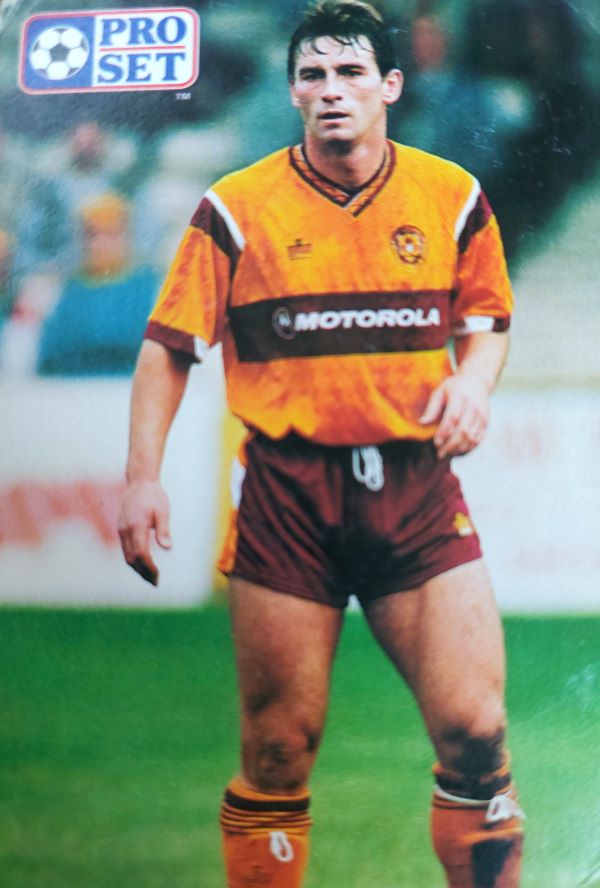
However, the Well came crashing back down to earth three days later with a 2-0 home defeat at the hands of Alec Miller’s Hibernian. Tommy McLean’s side regrouped and enjoyed a six-match unbeaten run before falling 2-0 to Celtic at Parkhead on 24 November. A month earlier, the Parkhead side had appointed Lou Macari as their new manager, following Liam Brady’s resignation.
Celtic’s rivals Rangers exacted revenge on Motherwell with a 2-0 win at Fir Park on 4 December, and, a week later, the Steelmen lost 3-2 in a thrilling encounter against Hibs at Easter Road. Both Motherwell goals were scored by Irish international striker Tommy Coyne – his first goals for the club – who had joined from Tranmere Rovers that summer. Coyne’s second strike – a first time lob – was particularly clinical, and the sight of the Irishman hitting the net was something Well fans would become very familiar with over the following five years.
Tommy McLean’s side finished 1993 with two away league victories. Four days after the defeat at Easter Road, Motherwell were back in the capital to face Hearts at Tynecastle. Coyne scored his third and fourth goals in claret and amber, and this time his side were on the right end of a 3-2 scoreline. This was followed by a 3-1 victory over Dundee at Dens Park a week before Christmas.
As the New Year began, Motherwell sat in third place with 30 points from 24 games – two points ahead of Celtic in fourth spot and a point behind Aberdeen in second; Rangers topped the table on 32 points, having played a game more than their rivals. The New Year brought a very welcome six-game unbeaten run for Motherwell, which included two wins over Celtic, one in league business and one in the Scottish Cup. The league win was secured courtesy of two fine goals by classy midfielder Phil O’Donnell, who would go on to sign for Celtic in the summer of 1994.
Following a narrow defeat at Ibrox against title challengers Rangers on 5 March, the Steelmen solidified their league challenge with a 10-game unbeaten league run. During this run, the Well drew twice with Aberdeen, also battling for the title, beat Celtic again and enjoyed a fine 2-0 victory over Hibernian at Easter Road.
With five games of the season remaining, Walter Smith’s Rangers came to Fir Park with a seven-point lead over McLean’s Motherwell. Rangers, as we will read more about later, had enjoyed a 17-game unbeaten run spanning the end of 1993 and well into the New Year. If the Steelmen were to have any chance of competing for the title, a win would be essential. An action-packed first half saw the sides share three goals. Well midfielder John Philliben fired the home side in front but Ally McCoist drew Rangers level with a close range header. A minute before the break, Motherwell were awarded a penalty when Trevor Steven bundled Paul Lambert over in the box. Tommy Coyne made no mistake from the spot, sending former Well goalkeeper Ally Maxwell the wrong way to secure his eleventh goal of the season. A goalless second half meant a crucial two points for Motherwell, which they followed up with a 1-0 home victory over Kilmarnock four days later.
Would this late season surge be enough to see McLean’s side overhaul Rangers’ lead at the top and secure the most unlikely of league triumphs?
Season 93/94: Aberdeen
Aberdeen, managed by club legend Willie Miller, went into season 1993/94 hoping to finally get the better of Rangers. In four of the previous five seasons, the Dons had finished in second place, with Rangers taking the title each time. Season 1990/91 had been the most agonising for the Dons, as they led the title fight going into the final day of the season, only to lose 2-0 at Ibrox and hand Rangers their third successive league triumph. In addition to finishing runners-up in season 1992/93, Miller’s side lost both domestic cup finals to Rangers, who secured a treble of Premier Division, League Cup and Scottish Cup.
After a mixed start to the 93/94 campaign – two wins, three draws and a defeat in their opening six league games – the Dons signalled their title intent by defeating Rangers 2-0 at Pittodrie on 18 September. A clinical finish by Duncan Shearer and an own goal from Rangers’ Steven Pressley secured the points for the Dons in front of almost 20,000 fans. The Dons only lost one league match – a 3-2 defeat at Partick Thistle – before the two sides met again at Ibrox on 1 December. In an alarmingly similar outcome to the league title decider in 1991, Gers striker Mark Hateley twice got the better of Dons’ keeper Michael Watt to give the Glasgow side a 2-0 victory and hand Aberdeen their third league defeat of the season.
However, the loss at Ibrox sparked an unbeaten run for Willie Miller’s side, who won four and drew five of their following nine league matches. The final match of this sequence was a goalless draw with Rangers at Pittodrie on 22 January. A visit to the capital to face Hibs followed. Despite taking the lead courtesy of a long-range strike from English midfielder Lee Richardson, the Dons fell to a 3-1 defeat. This was their second loss at Easter Road of the season – the Edinburgh side having handed the Dons their first league defeat of the campaign back in September.
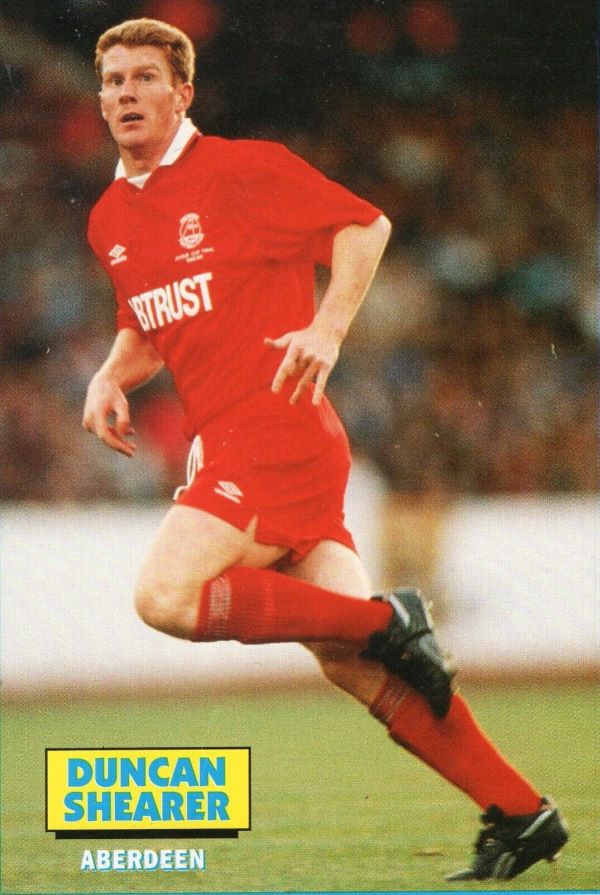
Miller’s side quickly recovered from the set-back in Edinburgh by putting four goals past Raith Rovers without reply. Duncan Shearer, who would finish the season as the Dons top scorer with 26 goals in all competitions, was on target. Shearer’s Finnish strike partner Mixu Paatelainen bagged a brace before Scott Booth completed the scoring. The clean sheet was ensured when Dutch goalkeeper Theo Snelders made a fine penalty save. Hibernian’s capital city rivals Hearts then travelled to Pittodrie on 5 March and left the Granite City with a 1-0 win.
The prolific Duncan Shearer scored in each of Aberdeen’s following three league games – a draw with fellow title challengers Motherwell and victories over Kilmarnock and Dundee United – before the Edinburgh side curse struck again. Former Dons keeper Jim Leighton – now playing for Hibs – saved a Shearer spot-kick as his side beat the Dons 3-2 at Pittodrie.
The reverse against Hibs turned out to be the Dons’ final defeat of the league campaign. Although a 1-1 result against Rangers at Ibrox four days after the Hibs defeat was welcomed, draws were having a major impact on the Dons’ title challenge – another five followed in Aberdeen’s final eight league matches.
Despite the abundance of draws – Willie Miller’s side were held in 21 of their 44 league matches – the unbeaten end to the campaign kept the Dons in the title hunt. Would Rangers’ experience see them over the line once again?
Season 93/94: Rangers
Walter Smith’s Rangers – in pursuit of their sixth consecutive league title – could be forgiven for having a slightly lacklustre 1993/94 campaign. The previous season, Rangers won a domestic treble – winning 33 of 44 league games and beating Aberdeen in the League Cup and Scottish Cup finals – while narrowly losing out to Marseille for a spot in the Champions League Final, having finished the competition’s group stage unbeaten after six matches.
So, how could they possibly top this is season 93/94? The campaign began with victories over Hearts and St Johnstone, followed by a 0-0 draw with Celtic at Parkhead. However, when newly-promoted Kilmarnock took the spoils from Ibrox on the fourth week of the season – ending Rangers’ 17-month unbeaten home record in the process – it was a sign that the champions wouldn’t have things all their own way. Draws against Dundee United and Partick Thistle followed, before Aberdeen’s 2-0 triumph over Rangers at Pittodrie.
Rangers suffered a further three league defeats before Christmas, all at Ibrox. As we learned above, Tommy McLean’s Motherwell signalled their title intent with a 2-1 victory in Glasgow on 6 October, and Celtic triumphed by the same scoreline in the season’s second Old Firm derby the day before Halloween. The defeat against their oldest rivals was followed by an eight-game unbeaten league run, which, crucially, included victories over title challengers Aberdeen and Motherwell. However, the Ibrox crowd was silenced on 11 December when Dundee United visited Glasgow’s south side and left with a 3-0 victory. There were only 21 seconds on the clock when the visitors – managed by the Bohemian Ivan Golac – went in front. Twenty minutes later, United were celebrating their third goal of the afternoon – Craig Brewster adding to Paddy Connolly’s fifteenth minute strike. Smith’s side lost central defenders Dave McPherson and Richard Gough in what turned out to be an injury-ravaged campaign for the club.
A 4-0 victory for Rangers at St Johnstone followed the miserable afternoon against United. As Christmas arrived, the Gers were involved in a four-way battle for the title alongside Aberdeen, Motherwell and Celtic. The Parkhead club had enjoyed an initial ‘new-manager-bounce’ in fortunes following the appointment of Lou Macari in October – the 2-1 win at Ibrox was Macari’s first game in charge. The New Year began with the traditional New Year’s Day derby match. Rangers travelled across the city with a two-point lead over their rivals, though Macari’s side had played one game fewer.
In what was Walter Smith’s side’s strongest performance of the season, Rangers raced into a three-goal lead in the first half hour. Mark Hateley (enjoying his most prolific season at Rangers, finishing the league’s top scorer with 22 goals and notching 30 in all competitions) scored within the game’s opening minute, before Ukrainian Alexi Mikhailichenko added a brace. A John Collins strike at the start of the second half brought Celtic back into the match, and they spent large spells of the second half closing in on another goal. However, Mikhailichenko’s compatriot Oleg Kuznetsov restored Rangers’ three-goal cushion with a dipping volley (his only goal for the club) in the seventy-sixth minute. Charlie Nicholas pulled another goal back for the home side, but Rangers ran out 4-2 winners.
Macari’s tenure at Parkhead unravelled with subsequent defeats to Partick Thistle and Motherwell, which put paid to any hopes his side had of battling for the title. In contrast, the New Year saw Rangers enjoy their strongest spell of the season; the Old Firm victory was the third match of a 17-game unbeaten league run, which included a string of seven consecutive victories. Two draws against Aberdeen and a win over Motherwell kept Rangers’ closest challengers at arm’s length.
As we read earlier, when Walter Smith’s side arrived at Fir Park on 26 April, they had a seven-point lead over Tommy McLean’s Motherwell. Victory for Rangers would have ended the Steelmen’s interest in the title but, instead, the gap was cut to five points with four games remaining.
If Motherwell fans were to know that Rangers would take only two points from their final four games – Walter Smith’s side drew at home to Celtic and Dundee and lost on the road to Hibs and Kilmarnock – and score only a single goal in the process, a remarkable title triumph would have been a real possibility. However, four wins from four for Tommy McLean’s side would have been required.
Motherwell’s victory over Rangers was followed by a narrow 1-0 win over Kilmarnock at Fir Park. The draw between Rangers and Celtic that same afternoon narrowed the gap to four points, with Aberdeen a further three points behind the Steelmen. The following midweek, Motherwell’s title challenge all but ended when Dundee United took the spoils from Fir Park with a 2-1 win. A 1-0 defeat for Rangers in the capital against Hibs that same evening left Well fans with an awful sense of what might have been. Although not mathematically certain, Rangers’ far superior goal difference all but secured them the title with two games to spare.
A 3-3 draw at Raith Rovers and a final day defeat at home to St Johnstone – who were battling for Premier League survival – saw Motherwell slip to third place, behind Rangers and Aberdeen. Despite their plethora of draws, back-to-back away wins against Raith Rovers and St Johnstone and a final day draw at home to Celtic were enough to see Willie Miller’s Dons leapfrog Motherwell (Aberdeen’s fifth second place finish in six seasons); both sides qualified for the following season’s UEFA Cup.
Ultimately, Rangers’ 17-game unbeaten run, and the ability to get themselves over the line, even when their squad was stretched due to injuries, brought them a sixth consecutive title. The importance of the arrival of Gordon Durie, signed from Tottenham Hotspur for £1.2 million in November 1993, cannot be downplayed either; the striker went on to score 13 goals in his first season at Ibrox.
To say the title race was a fight to the death would be a stretch, but Aberdeen and Motherwell could certainly look back on a number of missed opportunities during a season where Rangers displayed an uncharacteristic vulnerability. Neither Willie Miller nor Tommy McLean’s sides secured the biggest prize, however, no team outside of Rangers and Celtic has come as close to winning the top flight since.
Season 93/94: the relegation battle
The top flight title race may not have reached the final day, but the battle for survival certainly did. Going into the final afternoon of fixtures on Saturday 14 May 1994, four teams were fighting to avoid joining already doomed Dundee and Raith Rovers in the last of three relegation spots.
St Johnstone, managed by Paul Sturrock, who had replaced John McClelland in November 1993, occupied third bottom spot going into the final weekend. Tommy Burns’ Kilmarnock, who had been promoted to the top flight alongside First Division champions Raith Rovers the previous summer, sat a single point ahead in ninth position. Partick Thistle and Hearts – who faced each other on the final day – had both accumulated a point more than Kilmarnock. A final day defeat for either side could see them in grave danger of relegation.
For St Johnstone, the task was simple: win away at Motherwell and hope other results go in your favour. And Paul Sturrock’s side did just that. A 1-0 win at Fir Park secured a crucial two points for the Saints and saw them end the campaign on 40 points with a -12 goal difference. Would this be enough to extend the Perth club’s three-year stay in the top flight?
There was sunshine on Leith as a travelling away support of around 6,000 Kilmarnock fans descended on the capital city to watch their side take on Hibernian at a sun-kissed Easter Road. Led by their inspirational player-manager Tommy Burns, Kilmarnock had given themselves a great chance of avoiding the drop by defeating Rangers 1-0 at Rugby Park the previous weekend.
In a nerve-shredding afternoon for the away supporters, Kilmarnock got themselves over the line as they shared a point apiece with the hosts following a 0-0 draw. The news filtering through that St Johnstone were in front at Fir Park only served to heighten the tension in the Easter Road visitors’ section. A single goal for Hibs would have sent Kilmarnock back to Division One; however, Burns and his men held firm and, in truth, looked the more likely side to score themselves.
So, with Kilmarnock safe, it’s over to Hearts and Partick Thistle. For Sandy Clark’s Hearts, this was new territory; the Jambos had qualified for Europe in each of the preceding two seasons – finishing second in season 1991/92 and fifth the following campaign. In 93/94, Clark’s side drew 20 of 44 league games. Between 2 October 1993 and 15 January 1994, they won only one of 18 league matches – though crucially for Hearts fans, and perhaps Sandy Clark’s employment status, this win came in an Edinburgh derby match at Easter Road. This run of form goes some way to explaining why Hearts found themselves in such an unfamiliar position going into the final day’s play.
Partick, led by the irrepressible John Lambie in the dugout, were looking to secure top flight football for the third consecutive season. Having been promoted alongside First Division champions Dundee in 1992, the Jags finished the 1992/93 Premier League campaign in a relatively comfortable eighth place. The 93/94 season had been less smooth, but an unbeaten run of three games (a win over Dundee and a draw with Raith at Firhill were followed by an impressive 1-1 draw against Celtic at Parkhead) leading up to the final day meant that Partick’s fate was in their own hands.
Partick and Hearts knew that a draw would keep both sides in the top flight, and for much of the afternoon any other outcome seemed less likely than a Scotland World Cup triumph. However, Hearts’ defender Alan McLaren forgot about the script; with three minutes remaining, McLaren’s header from a corner found its way into the Partick net to set up a tense finale. Another goal for Hearts would have given the Jags a goal difference of -12, the same as St Johnstone. If the Saints could find another goal at Fir Park, Partick would be doomed. Perhaps not in keeping with a chaotic campaign, no further goals were scored at either venue, meaning, despite their best efforts, Paul Sturrock’s St Johnstone were relegated alongside Raith Rovers and Dundee.
If relegating a quarter of the league seems harsh, more than a thought should be spared for the lower league sides that same season. Five of the 12-team First Division were relegated to the Second Division, while the bottom eight sides in the 14-team Second Division would form the new Third Division, alongside new arrivals to the senior set-up Caledonian Thistle and Ross County.
So, there we have it, 93/94 was quite the season in Scottish football, and we’ve yet to properly discuss Ivan Golac’s Dundee United…
 Scottish Football Stories
2 thoughts on “Remember the time when… the top flight had a three-way title fight; and three teams faced the drop”