Do many people refer to the Scotland national team’s 1991-94 home jersey as their favourite of all time? Arguably not, but it’s certainly one of the most iconic.
As the 1990s, and the ever-increasing digital world, were taking shape, staff at Umbro Towers appeared to have been let loose on a new graphic design program. The classic navy blue remained, but the standard plain template for Scotland jerseys sat at the bottom of the Umbro office bin. A triangular motif (with horizontal lines inside the triangle) appeared on the right sleeve of the jersey, the left leg of the white shorts and the red tops of the navy-blue socks. The SFA was represented on the shirts with the letters appearing in an abstract (is that the right term, design friends?) pattern splashed across the main body. The letters also appeared on a white square at the bottom of a buttoned polo collar. Sound interesting? Well, surprising as it may sound, it all worked very well! And, believe it or not, the home kit was much more subtly designed than the corresponding away and goalkeeper offerings.
The kit made its debut in a Euro 92 qualifier against Bulgaria at Hampden in March 1991. John Collins was the first player to score in the new jersey, with an uncharacteristic bullet header giving the hosts the lead. Bulgaria scored a late equaliser, but Andy Roxburgh’s men eventually finished top of a tough group – that also included Romania, San Marino, and Switzerland – to qualify for the European Championships for the first time.
So, this bold new kit took centre stage in Sweden as Scotland lined up against the Netherlands, Germany, and the CIS in Group B. Perhaps the strip’s most famous outing was the final group match, a 3-0 victory for the Scots against the CIS. Unfortunately, narrow defeats to the Netherlands and Germany had dashed any Scottish hopes of reaching the Euro 92 semi-finals.
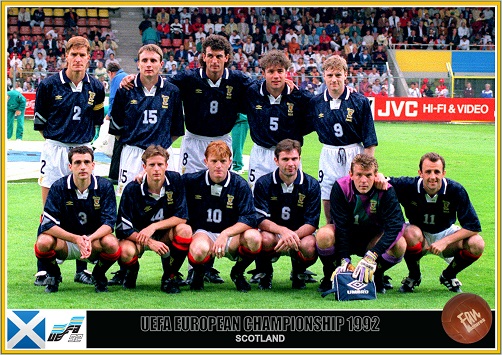
Due to some peculiar SFA decision-making (who would believe it, eh?), the Scottish players wore numbers relating to how many appearances they had made; Richard Gough was the outfield player with the most caps, so he wore number two. This explains why Ally McCoist sported the unfamiliar number five and right-back Stewart McKimmie donned number nine. The numbers policy had also been adopted by the SFA at the 1990 World Cup in Italy. For the first time, the players’ numbers appeared on the front of the jersey as well as the back.

Younger readers may be shocked to learn that Scotland wore the ‘graphic design’ strip for three years. When it came to replacing the jersey in 1994, Umbro were no less adventurous. This time they opted for a tartan design, which the national side, now managed by Craig Brown, wore at the next European Champions, hosted by England in 1996.
 Scottish Football Stories