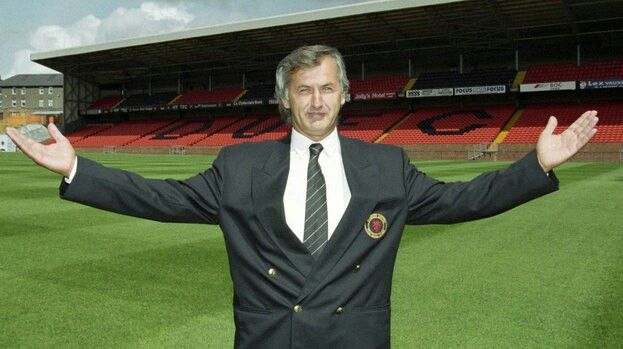
When Ivan Golac spoke to the press for the first time as Dundee United manager, he described himself as ‘confident’. Confidence is a very useful trait to have if you’re replacing Jim McLean in the hottest of hot seats.
It’s July 1993. Take That are top of the charts with Pray, and praying is what some Dundee United fans are doing ahead of the new Premier League campaign. Jim McLean, Mr Dundee United himself, has stepped away from his manager’s position to move upstairs to the role of club chairman. McLean has been manager since 1971 and in those 22 years has transformed the club from a middle-of-the-road side to a European force. On the domestic front, McLean secured Dundee United’s first-ever top-flight league triumph in season 1982/83 and won the League Cup in consecutive years, 1980 and 1981. On the continent, McLean led the Tannadice side to the European Cup semi-finals in 1984, where they were eventually beaten by Italian side Roma, and to the UEFA Cup Final in 1987, where United lost out to Swedish side IFK Gothenburg.
Who is Ivan Golac?
So, not an easy task for Ivan Golac. But who was the man Dundee United had appointed to succeed McLean? The words ‘bohemian’ and ‘maverick’ are often used to describe the former Yugoslav international, who made his name as a player for Partizan Belgrade before moving to Southampton. It would be quite the change at Tannadice from the austere, disciplinarian style of management adopted by McLean for more than two decades.
Interestingly, Golac made his management debut for Partizan Belgrade in Scotland. Having returned to Belgrade at the end of his playing career, Golac took up a coaching role at Partizan before being appointed assistant manager. In September 1989, on the eve of a European Cup Winners’ Cup second leg tie against Celtic, Partizan manager Momčilo Vukotić took ill, and Golac found himself in charge for the match at Parkhead. A remarkable match saw Celtic win 5-4, but Partizan’s 2-1 first leg victory meant Golac’s side progressed on away goals.
Golac almost returned to the Parkhead dugout – the home one, this time – when he applied for the vacant Celtic job in 1991. Ultimately, the Hoops appointed Irishman Liam Brady but, two years later, Golac was back in Scotland when Dundee United came calling.
That same summer of ’93, United sold star striker Duncan Ferguson to Rangers for £4 million. Ferguson’s replacement, Raith Rovers striker Craig Brewster, seemed an underwhelming signing at first, but, less than a year later, he would write himself into the Dundee United history books with one of the most important goals in the club’s existence. Other new signings included Golac’s compatriot Gordan Petric, a classy defender who signed for a club record £600,000, and Trinidadian striker Jerren Nixon. The new additions joined a strong first team squad captained by Maurice Malpas.
Golac’s United began the season with an unbeaten run of eight games in the league, albeit they only took maximum points from two of these matches. Crucially, though, Golac tasted success in his first Dundee derby, Andy McLaren scoring the only goal in a 1-0 home victory for United on 11 September; Golac appeared to get into the spirit of the derby himself when he was involved in a touchline altercation with Dundee’s Slovakian midfielder Dusan Vrto.
Despite a promising start to the league campaign, Golac’s men fell at the first hurdle in Europe. United qualified for the UEFA Cup courtesy of a fourth-place league finish the previous season but they dropped out at the First Round after an away goals defeat to Danish side Brondby. Sandwiched between the two legs against Brondby, United narrowly missed out on a place in the League Cup Final after losing 1-0 to Hibernian in the semi-final at Tynecastle. The Edinburgh side also ended United’s unbeaten league run with a 2-0 victory at Easter Road on 2 October, former Tangerine Darren Jackson adding two more goals to his solitary strike in the semi-final. League defeats to Rangers and Aberdeen soon followed, as the early season optimism surrounding Golac’s arrival was in danger of dissipating.
When United travelled to Ibrox to play champions Rangers (who were chasing their sixth consecutive Premier Division title) on 11 December, they did so with renewed vigour. Following defeat to Aberdeen, Golac’s men had lost only once in eight league matches. This run included a victory over Celtic and, four days prior to the trip to Ibrox, a 2-1 victory at Dens Park in the second Dundee derby of the season – Craig Brewster and Paddy Connolly were on target for the visitors.
Remarkably – in what was the most commanding display of Golac’s tenure on Tayside – United had the points wrapped up at Ibrox within 20 minutes. There were only 21 seconds on the clock when Dave Bowman headed the visitors in front from a Connolly cross. Connolly added a second on 15 minutes before Brewster put United out of sight in the twenty-first minute. After the game, Golac spoke of the ‘great combination of skill and youth’ in his side and stated that ‘we know exactly in what direction we are heading’. To everyone else, though, this direction remained somewhat unclear, as United lost their final two league games before the New Year; defeat on the road to Partick Thistle was followed by a home loss to Aberdeen on 27 December.
United’s Hampden hoodoo
Despite Jim McLean’s unparalleled success at Tannadice, there was one domestic trophy that eluded him. In his 22 years in the dugout, McLean’s Dundee United reached the Scottish Cup final on six occasions but lost every match. Two years before Golan’s arrival, in one of the most exciting cup finals of the modern era, United lost 4-3 after extra time to Motherwell, who were managed by Jim’s younger brother Tommy McLean. Could Golac succeed where McLean hadn’t? The confident Golac certainly thought so. He felt there was ‘something special in the air’ when United took over 5,000 fans to Arbroath for the third-round tie in January 1994, which Golac’s side won 3-2.
The fourth-round gave United the chance to exact revenge on Motherwell – still managed by Tommy McLean – for the 1991 final defeat. Craig Brewster scored two fantastic goals, enhancing his reputation as United’s talisman, in a thriller at Tannadice. However, Motherwell scored two of their own and had it not been for a terrific penalty save from United’s Dutch goalkeeper Guido van de Kamp, the Lanarkshire club would have booked their spot in the quarter-finals. In a midweek replay at a blustery Fir Park, defender Brian Welsh popped up with a fantastic winning goal to keep United’s cup dream alive.
Another replay was required to defeat First Division Airdrie. Following a 0-0 draw at Airdrie’s Broomfield Park – a stuffy encounter that saw Brewster sent-off – United triumphed 2-0 at Tannadice to set up a semi-final showdown against Aberdeen at Hampden, a ground at which United hadn’t won a match in 13 years. Alongside Motherwell and Rangers, Aberdeen were involved in a three-way battle for the Premier Division title. Willie Miller’s side had also reached the Scottish Cup Final the previous season – losing out to treble-winning Rangers – so they fancied their chances of booking their place at another end of season showpiece. These hopes increased when Duncan Shearer’s shot squirmed under van de Kamp to give the Dons the lead early in the first half. Despite creating an abundance of opportunities, United struggled to find a way past veteran ‘keeper John Burridge in the Aberdeen goal. As the clock ticked towards the final minute, and just as it looked as though United’s Scottish Cup dream was over, Brian Welsh saved the day, once again. Welsh’s header from Dave Bowman’s lofted cross was expertly guided past the outstretched right hand of Burridge and into the bottom corner of the net. Was this late rescue mission a sign of change in United’s Hampden fortunes? Jim McInally certainly thought so. In the Hampden replay, the veteran defensive midfielder, who signed for the Tannadice club in 1986 and had played in three Scottish Cup final defeats, scored the only goal of the game, and his first of the 1993/94 season, to send United through to the final. It had been a gruelling run, but Golac remained unflappable as he stood on the brink of history in his first season in Scotland.
‘The best present our supporters ever had’
“As soon as I heard we were going to play Rangers, I knew there was only one winner…it was us.” Unsurprisingly, these aren’t the words of a Dundee United supporter, bruised and battered by years of Scottish Cup final heartache. When you’re facing a side on the verge of securing an unprecedented back-to-back domestic treble, it’s perhaps best that you’re marched into battle by a leader who appears to be blissfully unaware of history. “I had a feeling that Rangers didn’t fancy playing us,” Golac revealed on Dundee United’s end of season video review. Golac’s confidence seemed to be based on his side’s 3-0 win at Ibrox the previous December. However, Rangers had won two of the other three league meetings between the sides, while one encounter ended in a goalless draw at Tannadice. So, how did United prepare for the final? The day before the match, Golac took his players for a walk to smell the flowers at Dundee’s Camperdown Park!
Wildly unconventional Golac may have been, but, on this occasion, his methods delivered. On 21 May 1994, Dundee United won their first-ever Scottish Cup, beating Walter Smith’s Rangers by a single goal to nil. From the class and composure of Gordan Petric (whose performance earned him the official man-of-the-match award) in defence, to the energy and skill of Andy McLaren on the wing, United were the stronger side and deserved victors. In the 1991 final defeat, an inspired performance from Motherwell goalkeeper Ally Maxwell, who, remarkably, played on despite suffering an injury that turned out to be broken ribs and a ruptured spleen, had denied United. However, with Maxwell now in the Rangers goal, he had a big hand in United’s triumph in ’94. With 47 minutes on the clock, Maxwell sent an attempted clearance onto United’s Christian Daily, who had done well to close the ‘keeper down. In a resulting scramble for the ball, Daily got there ahead of Maxwell and sent a shot creeping towards the far corner. The army of United fans behind the goal in Hampden’s east stand held their breaths. ‘Daily, has he scored?’ asked Jock Brown on his cup final tv commentary. He hadn’t. But Craig Brewster wasn’t standing idle. When the ball rebounded off the post, United’s top scorer was on hand to slam his twentieth goal of the season into the empty net. The vital moment occurred a matter of inches from where McInally had secured United’s place in the final against Aberdeen.
Once the elation among the United support had somewhat eased, the nervous realisation dawned that there were still more than 40 minutes to play. Although Rangers pressed for a leveller, in truth, United goalkeeper Guido van de Kamp was only seriously troubled twice in the second half: the Dutchman thwarted Alexei Mikhailichenko from close range and was then relieved to gather a long-range effort from Mark Hateley at the second attempt after his initial block squirmed under him and trickled goalwards.
When the final whistle sounded, the United support exploded with joy. At the seventh attempt, the Hampden hoodoo had been vanquished. The celebrations continued from Glasgow’s southside back north to the City of Discovery, where a city-centre trophy parade took place the following day. The Scottish Cup win was later described by Golac as ‘the best present our supporters ever had’. Given the club’s success in the 1980s, it’s hard not to read this as a dose of Golac embellishment. Let’s not forget, Golac once claimed that striker Jerren Nixon would one day be worth £10 million; the Trinidadian was sold to FC Zurich in 1995 for £200,000.
The history books will state that Dundee United won the Scottish Cup and finished sixth in the Premier Division in season 1993/94. However, Golac’s side won only five matches during the second half of the league campaign and the 42 points they amassed were only two more than tenth-placed St Johnstone, who were relegated (alongside Raith Rovers and Dundee) from a crazily congested league.
Was Ivan Golac a good manager?
The opening day of a league campaign can set the tone for the months ahead. A convincing win sends the fans home happy. A draw will have some supporters grumbling, but most will realise the value of not losing. Even a narrow defeat can be forgiven if the performance suggests better days are in prospect. But there’s one golden rule: you don’t want to be on the end of a thumping on week one. On 13 August 1994, the opening day of the 94/95 Premier Division season, Dundee United were hammered 5-0 by Hibernian at Easter Road. Suddenly, the Scottish Cup success seemed a distant memory. United lost six of their opening 11 league games and were dumped out of the European Cup Winners’ Cup in the first round by Slovakian side Tatran Presov.
Inconsistent league form drew United into a relegation battle and, with pressure mounting, it appeared all was not well between manager Golac and chairman McLean. Following a Scottish Cup quarter-final defeat to Hearts on 12 March 1995, Golac lost his job as United manager. However, the change in the dugout didn’t have the desired effect; the Tangerines lost seven of their nine remaining league matches and, just under a year from the triumph at Hampden, were relegated from the Premier Division for the first time since its inception in 1975.
Perhaps unsurprisingly, Golac believes, had he been given more time in charge, he would have enjoyed further success at Tannadice. In an interview with the Courier, he said: “Losing my job was a shock and the way it was done was disappointing. I regret the way things ended because there was unfinished business to do. We would have won more trophies because we were at the start of something special.”
Was Ivan Golac a good manager? It’s a tough one to call. Take two games against Rangers out of the equation – the Scottish Cup Final victory and the impressive league win at Ibrox in December 1993 – and it would be very difficult to make a positive case. Had he stayed in charge, it’s hard to believe Golac would have reversed United’s seemingly ominous descent to Division One. However, Golac’s outlandish claims and brazen confidence gave Dundee United fans something to believe in; the cup final win in 1994 is fondly remembered as one of the finest afternoons in the club’s history.
What isn’t in doubt is Ivan Golac’s status as one of Scottish football’s great cult heroes.
 Scottish Football Stories