There are 42 minutes on the clock at Munich’s iconic Olympic Stadium. It’s a venue that has hosted the World Cup final and is home to one of world football’s most successful sides. It’s 31 October 1995, and Raith Rovers’ Danny Lennon, from the small West Lothian town of Whitburn, stands over the ball 25 yards from goal.
Between Lennon and the goal stands a wall comprising of Christian Nerlinger, Ciriaco Sforza, Dieter Hamman, Alexander Zickler and Thomas Strunz. Beat the wall, and there’s the not-so-small matter of Oliver Khan, one of German football’s greatest-ever goalkeepers, to contend with.
If you’re under 30 years old, you may well be scratching your head reading the above; however, it’s true, Raith Rovers were in Germany for a UEFA Cup second round tie against Bayern Munich. For the Kirkcaldy side, this was a journey that started more than a year earlier in the small town of Dingwall in the Scottish Highlands.
‘Whenever there is fun, there’s always Coca-Cola’
On August 17, 1994, First Division Raith Rovers defeated Ross County (one of two former Highland League sides who had been elected to the Scottish Third Division that summer) 5-0 in Dingwall to earn a place in the third round of the League Cup, sponsored at the time by Coca-Cola. Two weeks later, Rovers defeated Premier Division Kilmarnock 3-2 at home to book their place in the competition’s last eight. That same evening, cup holders Rangers suffered a shock 2-1 defeat at home to Falkirk and exited the tournament.
In a thrilling all First Division quarter-final, Rovers defeated St Johnstone 3-1 in Perth, meaning the Kirkcaldy side, led by Jimmy Nicholl as player manager, had reached their first cup semi-final in more than three decades. It would be First Division opposition once again for Nicholl’s side in the Coca-Cola Cup semi-final as they were drawn against Airdrie. The match would take place at Perth’s McDiarmid Park, the scene of Rovers’ quarter-final triumph. A good omen for the Kirkcaldy side?
Alex MacDonald’s Airdrie had a reputation for performing well in cup competitions. In 1992, they were narrowly defeated by Rangers in the Scottish Cup final. Their strong performance in the 1994/95 League Cup was followed with a run to the Scottish Cup final, where they lost to Celtic by a single goal.
‘What an incredible fairytale for Potter’
With 69 minutes on the clock at McDiarmid Park, Raith led Airdrie 1-0 – thanks to a first half goal from Ally Graham – and looked on course for a place in the Coca-Cola Cup final. However, when goalkeeper Scott Thomson raced from his goal to gather a long ball, he was adjudged to have handled outside the box and was sent off. With Thomson’s dismissal, Jimmy Nicholl turned to 17-year-old Brian Potter, who had made only one previous first team appearance between the sticks. One of Potter’s first tasks was to pick the ball out of the net following a brilliant long-range strike from Airdrie’s Steve Cooper, which brought the sides level. Potter, who could have done nothing about the goal, and his backline held firm for the rest of 90 minutes to take the tie to extra-time
As tired legs came to the fore, extra-time brought precious few chances, and the game drifted to the inevitable conclusion of the penalty shoot-out. A 17-year-old thrown on in a midweek cup semi-final under the floodlights; you’d be forgiven for thinking you were reading a football comic book. It was Brian Potter’s time to shine. With nine perfect penalties taken, Raith led 5-4 and Airdrie’s Alan Lawrence knew he would need to score to keep his side alive. Lawrence struck his shot powerfully; Potter dived to his right and the Raith Rovers end of the ground held its collective breath. ‘And Potter has saved it,’ boomed Jock Brown in his match commentary. ‘Raith Rovers are in the final, and 17-year-old Brian Potter has taken them there. What an incredible fairytale for Potter’.
The fairytale continues…
Despite his shoot-out heroics, Potter reverted to his substitute’s role for the final as Scott Thomson’s one-match suspension was served before the 27 November showpiece against Celtic, who had defeated Aberdeen in the other semi-final. Celtic were massive favourites for the match, but had the added pressure of not having lifted a trophy since 1989, a period in which their rivals Rangers had dominated the domestic game. Given that Celtic were playing home matches at Hampden Park during season 1994/95 – as their own ground was being rebuilt – the final was played at Ibrox.
The next chapter of Raith’s incredible fairytale was authored by 20-year-old striker Steve Crawford, who stunned the Ibrox crowd and the thousands watching on television when he fired Raith ahead with a right-foot shot in the 19th minute.
Celtic quickly set about their task of finding an equaliser, which came courtesy of a close-range Andy Walker header on 32 minutes; the sides went in level at the break. The second half brought little to choose between the teams as 30 minutes’ extra-time loomed. However, on 84 minutes, it appeared the Rovers fairytale had reached its conclusion when Charlie Nicholas pounced on a rebound to give Celtic a late 2-1 lead. Jimmy Nicholl’s Raith side were not to be deterred, though. Only two minutes after his side had taken the lead, Celtic goalkeeper Gordon Marshall could only parry a Jason Dair shot into the path of Rovers captain Gordon Dalziel, who coolly nodded home to bring the sides level again and take the final to extra-time.
After a goalless extra half hour, Jimmy Nicholl’s men faced another penalty shoot-out. A little over three months since defeating Ross County, the First Division side were a few kicks of the ball away from lifting their first-ever national trophy. Could Scott Thomson emulate Brian Potter’s semi-final heroics? Once again, Jock Brown’s commentary set the scene as Celtic captain Paul McStay stepped up to take his side’s sixth penalty, with Rovers ahead 6-5 in the shoot-out. “Unthinkable, surely for the skipper to miss,” predicted Brown. “But he has! Raith Rovers have won the Coca-Cola Cup. It’s quite amazing.” Like Potter, Thomson had dived to his right to save the crucial kick and write his name into the Scottish football history books.

Thomson’s save signalled an almighty party for everyone connected with the Kirkcaldy club. Once the hangovers had settled and players, staff and fans got used to a national cup taking pride of place in the trophy room, attention turned towards the next part of Rovers’ prize: European football.

European football arrives in Kirkcaldy
With the Coca-Cola Cup concluding before Christmas, Rovers fans had to wait almost nine months, and the dawn of the new season, before they could get their first taste of European football. Jimmy Nicholl’s side were now a Premier Division club, having added to their Coca-Cola Cup success by winning the First Division Championship. In a remarkable run of form, Rovers lost only one league match between Boxing Day and the end of season 1994/95. With two games remaining of the league campaign, Raith led rivals Dunfermline at the top of the table by three points. In keeping with the fairytale nature of the season, fate would have it that Dunfermline were to visit Starks Park for the league’s penultimate fixture. Having a considerably better goal difference than the hosts, Bert Paton’s Pars knew that a win would put their destiny in their own hands.
In a nervy 90 minutes, the Fife rivals played out a goalless draw meaning the destination of the title would be decided on the final weekend of the season. A week later, another goalless draw for Jimmy Nicholl’s side away to Hamilton secured the First Division Championship and an historic double for Rovers.
Three months later, it was finally time for European football to make its Starks Park debut. Gotu Itrottarfelag of Faroe Islands were the visitors for the first leg of the UEFA Cup preliminary round on 8 August 1995. A comprehensive 4-0 victory was followed by a 2-2 draw a fortnight later, meaning Rovers had qualified for the tournament’s first round proper, where they were drawn against Icelandic champions Akranes.
With a host of Icelandic internationals in their ranks, Akranes were expected to provide a sterner test for Rovers. However, within 15 minutes of the first leg in Kirkcaldy, Jimmy Nicholl’s side were ahead courtesy of a Danny Lennon strike. Rovers pressed for a second goal, but Akranes looked threatening going forward and found an equaliser just before the break. A tense second half awaited the more than 5,000 fans at Starks Park; the ground’s capacity had been reduced for the European fixture to comply with UEFA regulations. Perhaps having fallen foul of UEFA’s rules, television images from the match show three eager fans, complete with Saltire flag, sitting atop a chimney on a house overlooking the ground.
Akranes started the second half strongly, with Gunnlaugsson brothers Arnar and Bjarki looking particularly threatening. Later in his career, Arnar would go on to have a short spell at Dundee United, where he played six times.
Jimmy Nicholl’s side managed to stem the flow of Akranes attacks, and, on 66 minutes, Lennon fired home his second goal of the match to put Rovers 2-1 ahead. Not content with a single goal advantage, Raith continued to attack and got their reward with just over 10 minutes remaining when Barry Wilson’s deft finish gave them a 3-1 lead to take to Iceland.
Two weeks later in Iceland, Rovers put in a resolute, but nervy, defensive display – led by cup final hero Scott Thomson – in a single goal defeat that saw them progress to the UEFA Cup second round.
Rovers’ famous scoreboard moment
And so, we’ve arrived back in Munich and Danny Lennon standing over the dead ball, with the celebrated terraces of the Olympic Stadium providing a surreal backdrop for the side from Kirkcaldy. Having defeated Gotu Itrottarfelag and overcome Akranes, Rovers fans had the dream tie they had been hoping for. Given their normally impeccable high standards, Bayern Munich had something of a crisis in season 1994/95, finishing the German Bundesliga in sixth place and only just qualifying for a UEFA Cup first round spot. However, they had recently signed German World Cup winner Jurgen Klinsmann, one of the world’s best strikers, from Tottenham Hotspur to boost an attack that included French international Jean-Pierre Papin. Bayern had earned their place in the UEFA Cup’s second round by defeating Lokomotiv Moscow 5-1 on aggregate.
Lennon’s right-foot strike is decent, and good enough to beat the wall. It’s troubling enough for Andreas Herzog – standing between the wall and Kahn’s goal, and whose foul on Lennon led to the free-kick award – attempting a headed clearance. However, Herzog could only deflect the ball beyond a flat-footed Kahn and the net rippled. Bayern Munich 0-1 Raith Rovers.
Yes, you read that correctly, Bayern Munich 0-1 Raith Rovers. Three minutes later, the half-time whistle goes. This gives Raith fans 15 minutes to stare at the giant Olympic Stadium scoreboard. Bayern Munich 0-1 Raith Rovers.
Half of Kirkcaldy celebrates in Munich
Graeme Meldrum was one of those Rovers fans caught in a trance in the away end, enjoying the most celebrated half-time break in the club’s history. Fresh from a visit to the Olympic Stadium’s catering outlet, Graeme was confident enough in Danny Lennon’s set-piece abilities to leave his food and drink aside for a moment. “At this period in time, Danny Lennon was having a purple patch with free kicks,” Graeme recalls. “Indeed, the Saturday before, he hit the bar from further out against Rangers. So, I’d said to my brother ‘right, I’m putting this down just in case’. Twenty seconds later there was a huge silence in the away end as we all watched the sweetest struck free kick ever (who mentioned deflection?) fly past possibly the best ‘keeper in the world.
“It was pin drop time in the away end, then, all of a sudden, we realised what had happened and bedlam ensued – limbs, beer, food, scarves, hats and specs were all over the place. It was just unbelievable. Things we’d never thought possible or had dreamt about were coming true, and it felt like half of Kirkcaldy was there to see it.”
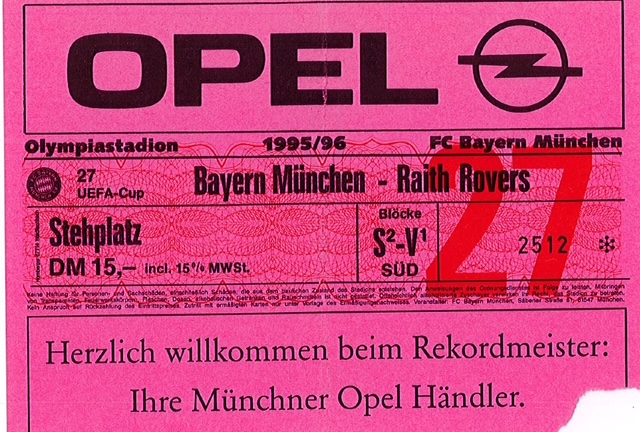
Two weeks earlier, in a match played at Hibernian’s Easter Road to maximise capacity and revenue, Bayern had defeated Rovers 2-0 in the second round first leg thanks to a goal in each half from Klinsmann. However, following the most famous moment in Danny Lennon’s football career, Jimmy Nicholl’s side were now very much back in the tie at one of world football’s most famous arenas. For Graeme, this was a far cry from his many years of following Raith. “I was there on a cold Tuesday night probably 10-11 years previously when we played Stranraer in front of 264 fans – our lowest recorded attendance, so this was just pipe dream stuff,” he says.

In a later interview, manager Jimmy Nicholl recalled the surreal atmosphere in the visitors’ dressing room as they listened to the Bayern players getting a half-time earbashing. “The Germans were all getting a rollicking at half-time,” he said. “You could hear it in the dressing room and the Raith players were getting a name-check. It was as if the Germans were turning round and saying ‘how can you be getting beaten 1-0 by blokes like Sinclair, Cameron and Dair? All my boys were listening for their names to get called out.”
Buoyed, or perhaps scared, by their half-time team-talk, Bayern quickly extinguished any hopes of Raith adding another chapter to their fairytale; Klinsmann scored his third goal of the tie five minutes after the restart, and Markus Babbel put the outcome beyond doubt shortly afterwards as the Germans progressed 4-1 on aggregate. Bayern went on to lift the UEFA Cup the following May, defeating French side Bordeaux 5-1 on aggregate. Raith can claim to have been one of only two sides to limit Bayern to as few as four goals over the two-legged ties on their route to lifting the trophy.
A ‘glorious time’ in the early 90s
Almost 30 years on from the Bayern tie, Graeme Meldrum is full of nostalgia when reflecting on a remarkable chapter in Raith’s history. “The wee period in the early 90’s was just exceptional,” he recalls fondly. “It was just a glorious time, and one I was fortunate to be able to see. I just wish the team could get back into the top league so my son could see us mixing it with the big boys in Scotland again.”

Given the ever-increasing gulf between football’s ‘elite’ and the chasing pack, the thought of a club of Raith’s size leading Bayern Munich again any time soon is almost impossible to fathom. However, memories last forever. Would fans such as Graeme Meldrum swap those magical 25 minutes in Munich for a succession of Champions League appearances and a game swallowed up by money? Who is the real winner in football?
Thanks to Graeme Meldrum, Tony Fimister and Grace Fowlie for their contributions.
 Scottish Football Stories