On the eve of season 1995/96 – as the country basked in a rare heatwave summer – Celtic fans had reason to be optimistic. It had been just over a year since the side from Glasgow’s east end – a matter of hours from going out of business – had been rescued by Scots Canadian businessman Fergus McCann. The club’s first trophy in six years soon followed, secured with a 1-0 victory over Airdrie in the 1995 Scottish Cup final.
Fans were hungry for more success. Rivals Rangers, with the talismanic Dane Brian Laudrup in their ranks, were on a run of seven consecutive league titles, closing in on Celtic’s historic nine-in-a-row record. Rangers had also shocked British football by signing Paul Gascoigne from Lazio in the summer of 1995. As a peroxide-blonde-haired ‘Gazza’ greeted joyous Rangers fans at a sun-drenched Ibrox, it appeared things were only going to get brighter for the club. Celtic would need to act to keep pace.
Season 1995/96 was no ordinary campaign for Celtic. It brought a return to their Parkhead home; fans witnessed an exciting group of players playing attacking football under the guidance of a club legend, and they enjoyed a remarkable unbeaten run. But would it be enough to win the battle against rivals Rangers and bring the league title back to the east end of Glasgow?
Celtic 1995/96: The Manager
Tommy Burns, one of Celtic’s most-celebrated players, had been appointed manager of the club in July 1994. Burns had spent the previous four-and-a-half years at Kilmarnock as player manager and manager, having moved to Ayrshire from Celtic in December 1989.
As mentioned above, 1995 saw Celtic win their first trophy since 1989 – the year of Burns’ departure – so the new manager had already achieved his initial objective. However, his first year in the Celtic dugout had been far from plain sailing. In November 1994, an opportunity to banish the trophy hoodoo had been spurned when Burns’ side lost the Coca-Cola Cup final on penalty kicks to First Division Raith Rovers.
A frustrating league campaign – in which Celtic drew 18 of their 36 league matches – saw the Hoops finish in fourth place, behind champions Rangers, runners-up Motherwell and third place Hibernian.
However, the Scottish Cup success, and a 3-0 league win over Rangers in May meant Celtic finished the season with renewed vigour. Burns was committed to an attacking style of football – his side aiming to play with pace and conviction in the final third of the park – and, with a few important additions to his squad, he was optimistic of challenging rivals Rangers for the league crown.
Celtic 1995/96: Return Home
One of Fergus McCann’s main objectives on arrival in Glasgow was the redevelopment of Celtic Park.
As the Parkhead stadium underwent an extensive rebuilding project, (McCann wished to transform the old ground into a 60,000 all-seater arena) Celtic became tenants in the south side of Glasgow, playing home matches at Hampden Park for the duration of season 1994/95.
A new North Stand, comprising 27,000 seats and adding an imposing presence to the east end of Glasgow skyline, was ready for the 1995/96 campaign. The new structure towered over the Main Stand it faced, and provided a statement for the direction Celtic wanted to travel.

During the season, a temporary stand – seating 2,800 – was erected on the site of the former west terracing to boost capacity. At the opposite end of the ground, parked cars were visible behind the goals during some of the season’s early matches. However, work would soon start on the east side of the ground, with a new stand open for supporters the following season.
Celtic 1995/96: The Players
Pierre van Hooijdonk
Giant striker Pierre van Hooijdonk arrived in the east end of Glasgow midway through the 1994/95 season from Dutch side NAC Breda. He made an immediate impact, scoring on his debut against Hearts and adding a further seven goals before the end of the season, including the winner in the Scottish Cup final.
During season 1995/96, the Dutchman took his goalscoring exploits to a different level; thriving under Burns’ attacking system, van Hooijdonk found the net 32 times – his 26 league goals made him the Premier Division’s top scorer.
The relationship between van Hooijdonk and Celtic soured during the following season, and he was eventually sold to Nottingham Forest. He may not have left the club on friendly terms, but the Dutchman’s impact during the 1995/96 campaign was one of the major factors in Tommy Burns’ side being able to challenge Rangers once again.
Andreas Thom
Celtic paid Bayer Leverkusen a then club record £2.2 million to bring Andreas ‘Andy’ Thom to Parkhead in the summer of 1995.
The attacking midfielder had played for East Germany 51 times before making 10 appearances for the unified Germany during the 1990s, so he arrived in Glasgow with significant international pedigree.
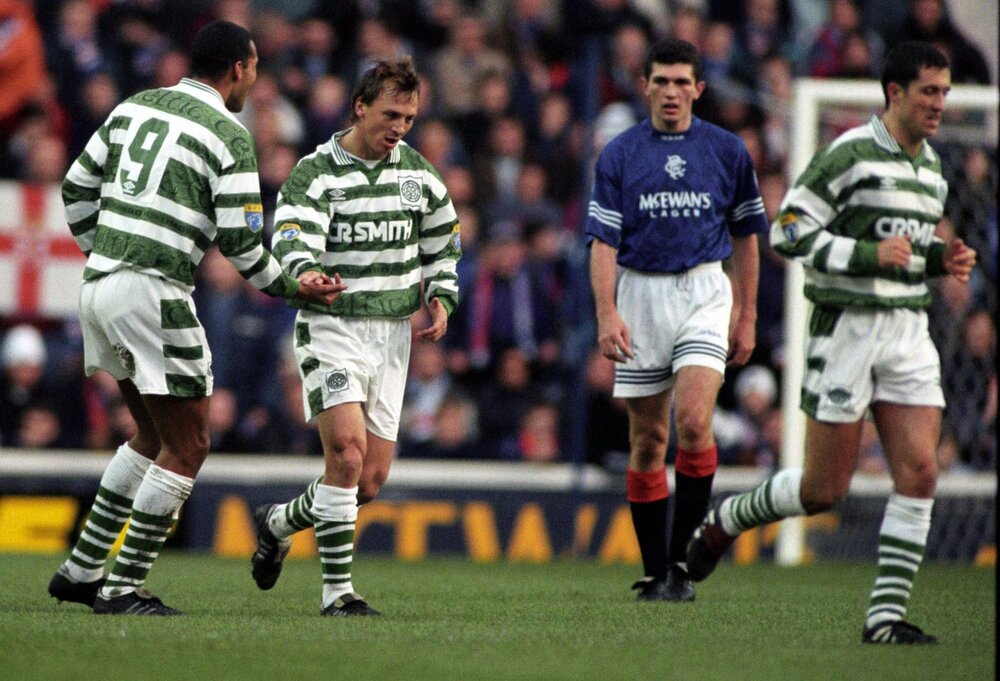
Thom quickly established an exciting partnership with van Hooijdonk and was at the heart of Celtic’s attacking moves. Thom had already shown signs of his class but confirmed his status among the Celtic support with a goal we will read more about later.
Jackie McNamara
The signing of youngster Jackie McNamara from Dunfermline may not have been greeted with the same fanfare as Thom’s arrival, but the right-back went on to have a major impact during his first season at Parkhead.
Arriving in October 1995, 22-year-old McNamara wasn’t initially expected to be an automatic starter, but he quickly made the right back spot his own, establishing a great understanding with fellow youngster Simon Donnelly, who was often deployed on the right-hand-side of midfield.
Such was McNamara’s impact he went on to win the SPFA Young Player of the Year award for season 1995/96.
John Collins
Unlike the above trio, John Collins was a long-established Celtic player by 1995. Having joined from Hibs in 1990, the left midfielder had been one of Celtic’s top performers during difficult times for the club.
Another player who thrived under Burns’ attacking system, Collins scored the first hat-trick of his senior career in a match against Hearts during the 95/96 campaign; this was also the first hat-trick scored by a Celtic player at Parkhead since October 1988.
Season 1995/96 would prove to be Collins’ last in the green and white hoops before he joined Monaco. However, he bowed out with some spectacular goals and assists.
Jorge Cadete
The signing of Portuguese striker Jorge Cadete in February 1996 was supposed to add further firepower to Celtic’s title push. However, due to a controversial six-week delay in the former Sporting Lisbon striker’s registration – which ultimately cost SFA Chief Executive Jim Farry his job – Cadete didn’t make his debut until April.
When his debut eventually arrived against Aberdeen, Cadete showed the Parkhead crowd what they had been waiting for. Within minutes of a thunderous applause welcoming his appearance as a substitute, the Portuguese striker found the net with a deft chip over visiting goalkeeper Michael Watt.

against Aberdeen, April 1996. PIC: The Celtic Wiki
Cadete scored a further five goals before the end of the season, but Celtic fans were left wondering what might have been had the Portuguese star been available for selection earlier in the campaign.
Celtic 1995/96: The Matches
Aberdeen 2-3 Celtic, 10 September 1995
With only 10 minutes played in Celtic’s second league game of the season, it looked like their campaign was crumbling before it had properly begun. Eoin Jess had scored Aberdeen’s second goal of the afternoon, three minutes after Tom Boyd had put through his own net following a mix-up with ‘keeper Gordon Marshall.
However, in a whirlwind 17-minute spell, Burns’ side turned the game on its head. On 21 minutes, John Collins halved the deficit with a superb shot with the outside of his left foot, which clipped the upright on its way to the top corner. Twelve minutes later, a cross-come-shot from Andy Thom sailed over Theo Snelders in the Aberdeen goal before dropping into the net via the far post.
A left-foot strike from Thom on 38 minutes caused Snelders more problems; the Dutchman could only parry the strike into the path of Collins, who lashed home the rebound to complete a remarkable first half comeback.
There were no further goals during the game’s second period; having won their opening league match 1-0 at Raith Rovers, Celtic found themselves with maximum points following their early scare in the north-east.
Rangers 3-3 Celtic, 19 November 1995
Every so often, a moment in football arises where a player produces something so spectacular it forever defines their spell with a club (think John Clark’s goal for Dundee United in the Nou Camp or, if you prefer, Tommy Steele for Stenhousemuir against Aberdeen). Mention the name ‘Andreas Thom’ and the word ‘Celtic’, and one such memory springs to mind.
Thom had already found the net six times for Celtic before they visited Ibrox on 19 November 1995 to play rivals Rangers – who had a four-point lead at the top of the table – but his seventh goal for the club defined him as a favourite of the Parkhead support.
With only nine minutes on the clock, and in front of a live television audience, the German unleashed a thunderbolt shot from 25 yards that flew past a shocked Andy Goram to give Celtic the lead at the home of their great rivals. ‘Incredible’, ‘mighty’, ‘awesome,’ ‘stunning’ and ‘magnificent’ were the words used by commentator Gerry McNee, in an explosion of adjectives – but a magnificent strike it was.
Burns’ side led for a further half hour before Brian Laudrup restored parity on 39 minutes with a smart, side-foot finish from the edge of the box. Six minutes after the restart, Celtic were back in front, when John Collins coolly dispatched a penalty beyond Goram’s grasp. This time, the lead lasted a little over 10 minutes; a free-kick from Paul Gascoigne found the head of Ally McCoist, who expertly nodded home from six yards. So, 63 minutes on the clock and Rangers and Celtic were locked at two goals apiece.
Pierre van Hooijdonk thought he had given Celtic their third lead of the match, only to be denied by an outstanding save from Goram. The Dutchman met Tosh McKinlay’s pinpoint cross first time on the volley; however, van Hooijdonk’s effort from six yards was somehow turned round the post by Goram’s right arm. It was a remarkable stop and, at risk of delving into the world of Scottish football cliches, had the save been made by [insert England international goalkeeper’s name] it would be widely regarded as one of the greatest of all time.
McKinlay’s involvement was far from done; in the 71st minute, Celtic’s left-back turned Oleg Salenko’s cross into his own net to give Rangers the lead for the first time in the match. Had McKinlay not intervened, McCoist would have been on hand to tap into the empty net. Within two minutes, however, it was all square again. Another precision cross from McKinlay was met by the head of van Hooijdonk, who, this time, made no mistake with his finish.
The Dutchman’s goal brought an end to the scoring in what is widely regarded as one of the most pulsating Old Firm clashes in recent decades.
Hibernian 0-4 Celtic, 9 December 1995
If a single goal encapsulated the attacking style of play Tommy Burns had brought to the east end of Glasgow, and the confidence this inspired in his players, it was arguably Jackie McNamara’s first for Celtic.
With 11 minutes on the clock at Easter Road, Celtic and their hosts, Hibernian, were looking for the all-important breakthrough. Receiving a pass from Paul McStay wide on the right-hand-side, McNamara played the ball into the feet of Pierre van Hooijdonk. Rather than stand on ceremony, the full-back darted towards the Hibernian box. Simon Donnelly, who had received the ball from van Hooijdonk, then played a clipped pass over the top of the Hibernian defence, which McNamara met first time, lifting the ball over goalkeeper Jim Leighton’s head and into the net. It was a superb goal and an important moment for McNamara, who had joined the Parkhead club two months earlier.
Darren Dods saw red for the hosts when he pushed Phil O’Donnell to the ground, but Celtic were already on course for victory. O’Donnell made it 2-0 in the 26th minute, finishing off another sweeping move by the visitors, and further goals were added in the second half by van Hooijdonk and Donnelly.
The nature of the victory and performance garnered Celtic many plaudits, with many believing they were ready to offer a sustained title challenge to rivals Rangers.
Celtic 5-0 Aberdeen, 1 April 1996
The noise created by Celtic fans when Jorge Cadete scored his first goal for the club was so loud it blew the Radio 5 Live transmission off air for a couple of seconds. The 5 Live broadcasting equipment had already endured a thorough testing that evening as Celtic swept Aberdeen aside in an emphatic display – Cadete’s goal was his side’s fifth without reply in a crushing victory.
Having been made to wait by the SFA to make his debut, the Portuguese striker grabbed the headlines, but it was the performance of the season’s unsung hero that was key to Celtic’s victory; Tosh McKinlay was directly involved in four of his side’s five goals. There were only two minutes on the clock when a trademark McKinlay cross was met by the head of Simon Donnelly (another player who had enjoyed an excellent campaign), who guided the ball into the bottom corner of Aberdeen goalkeeper Michael Watt’s net. Fifteen minutes later, McKinlay’s searching ball from deep inside Celtic’s own half was met by van Hooijdonk; the Dutchman sent the ball soaring over the head of the advancing Watt. When it came back down from the sky, the ball took a bounce before hitting the roof of the Aberdeen net.
Midway through the second half, McKinlay embarked on a marauding run with the ball deep into Aberdeen territory. He passed to Tom Boyd, whose lay off at the edge of the box was met by Donnelly, who lashed home his second goal of the evening to put the hosts 3-0 ahead. McKinlay’s next assist was for van Hooijdonk; the left-back’s corner kick was perfect for the Dutchman, who sent a downward header beyond the hapless Watt.
The stage was now set for Cadete. Only two minutes after entering the pitch, the Portuguese striker raced onto a Peter Grant through ball before expertly clipping the ball over Watt and into the net. Cadete’s strike brought an end to the goalscoring on what was Celtic’s most dominant display since returning to their revamped home.
Celtic 1995/96: The Unbeaten Run
On 30 September 1995 – following three victories and a draw in their opening four league matches – Celtic lost 0-2 to Rangers at Parkhead. If Celtic fans were to know that this would be their only league defeat of the campaign, they’d be forgiven for thinking the title was heading to the east end of Glasgow.
Of the proceeding 31 league matches, Burns’ side won 21, but, crucially, drew 10. Frustratingly for Celtic, four of these draws came at their Parkhead home. Following defeat to Rangers in September, the next three Old Firm matches of the league campaign were drawn; Rangers also knocked Celtic out of both domestic cup competitions.
There was little doubt Burns’ side had produced a memorable campaign, playing free-flowing, attacking football, but the elusive victory over Rangers, which would surely have given them the psychological advantage to go on and clinch the title, would not come.
When Rangers did slip up – the Ibrox side lost twice to Hearts and once to Hibernian during the league campaign – Celtic were unable to capitalise. On each occasion of Rangers losing to Hearts, Celtic drew with Kilmarnock. In the end, the Ibrox side won their eighth league championship in a row with a four-point advantage and a significantly better goal difference than their Glasgow rivals.
For a club of the stature of Celtic, it’s hard to fathom that one of the most memorable seasons in their recent history didn’t involve winning a trophy. However, their second-place finish was the club’s highest since winning the league in 1988.
Burns remained as Celtic manager for one more season. Despite the arrival of Paolo Di Canio bringing more flare and quality to his side, they were unable to prevent Rangers matching their record nine league titles in a row. Celtic would have to wait another year and for the arrival of Wim Jansen as manager, and Henrik Larsson as their talisman, to finally wrestle the league crown from their great rivals. But that’s a story for another day!
 Scottish Football Stories