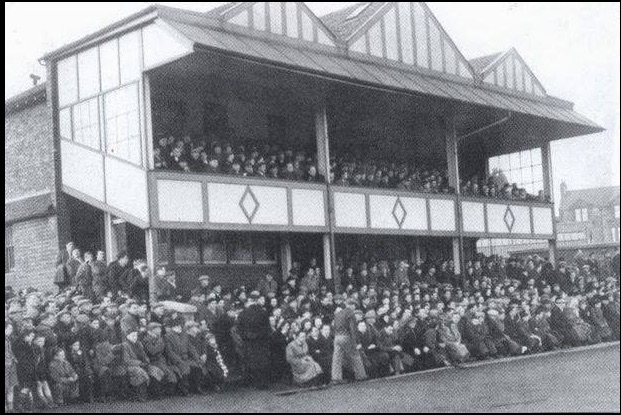
If you like your football of the nostalgic variety, there’s a fair chance you’d enjoy your games taking place at Airdrie’s old Broomfield Park; what’s not to love about a ground with a stand-alone pavilion at the corner flag?
Almost three decades have passed since the last ball was kicked at Broomfield in May 1994, but it’s a stadium that holds special memories for many.
The pavilion was Broomfield’s unique feature, and Airdrie fan John Henderson takes up the story of its history. “As is the case with many British football clubs, the birth of Airdrieonians (originally known as Excelsior FC) came about when the members of one of the local cricket clubs (Airdrie CC) decided in 1878 that they would form a football club to keep themselves occupied through the winter months,” he says. “It just happened to be the case that a benefactor had recently upgraded the facilities at the cricket field, and that work included the building of a new pavilion/dressing room area. In 1892, when the footballers were able to move to an improved ground (Broomfield) they included a pavilion, which was situated at the other end of the stadium [from the pavilion that stood until 1994]. That second pavilion was constructed in 1907 (financed by a director) and did not change drastically throughout the remaining years spent at Broomfield.”
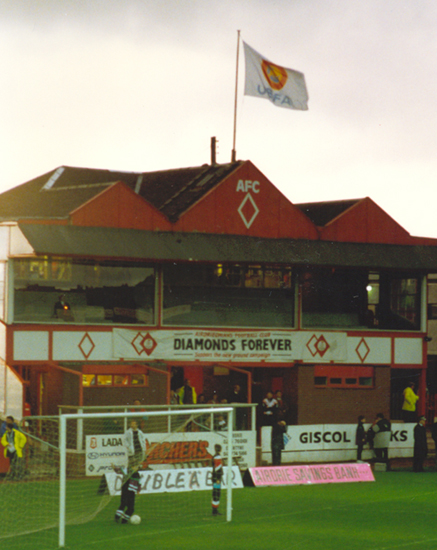
The Broomfield pavilion housed the ground’s changing rooms, and teams would enter the pitch from steps at either side of the iconic building. The top half provided seating for directors and club officials to take in the action. The pavilion was decorated with diamond motifs, in keeping with Airdrie’s nickname.
‘A tough place to go’
The years between 1922 and 1926 were the most successful in Airdrie’s history. They finished runners-up in the Scottish top-flight for four consecutive seasons, three times to Rangers and once to Celtic. The Diamonds lifted the Scottish Cup in 1924, defeating Hibernian 2-0 in the final, which was played at Ibrox Park. The period of success led to Airdrie building a main stand adjacent to the pavilion. Floodlights, another memorable feature of the ground, arrived in 1956.
When pictures of Broomfield – usually the iconic pavilion – appear on football nostalgia social media accounts, fans are quick to share memories; most comments focus on the ground being ‘a tough place to go’ for visiting teams. At just 67 yards wide, the Broomfield pitch was very narrow, and the home side rarely gave the opposition time to settle.

The narrowness of the Broomfield pitch and the tightness of the stands and terraces created an intimidating atmosphere. Airdrie fan John O’Brien fondly recalls many memorable nights at the old ground. “To the best of my memory, the first Airdrieonians game I attended was in November 1965 when Airdrie beat Ayr 1-0 in a Division Two league match,” he says. “Ian McMillan was playing along with Tommy Murray and Davie Marshall and the surprise for me was only scoring one goal as they had scored a stack of goals since the start of the season. Roddy Mackenzie, Paul Jonquin, Sam Goodwin, and Jim Black were all in that team. This was an absolutely fantastic group, that went on to win promotion to the top league.
“There was a great and noisy atmosphere and excellent support for the team from the terracing because of the way it was packed in; it was a wonderful first experience.”
John O’Brien
John attended many more memorable nights at Broomfield over the following three decades. The old Texaco Cup – a tournament between sides from Scotland, England and Ireland, which lasted for five seasons between 1970 and 1975 – brought an exciting new diversion from the regular Scottish league and cup action. “In the early 70s, the Texaco Cup brought some tremendous nights under the lights,” he recalls. “A 2-2 draw with Nottingham Forest in 1970, which included a brilliant penalty shoot-out experience. The wins over Manchester City and Huddersfield Town in that competition in 1971 also were great occasions. We had great wins over Celtic and Rangers at Broomfield…and playing in the Premier League for two seasons [1991/92 and 1992/93] there was terrific.”
European football comes to Airdrie
In season 1991/92, Airdrie reached the Scottish Cup final, losing 2-1 to Rangers at the Hampden show-piece. Despite the defeat – and given that Rangers’ league triumph brought them a spot in the 1992/93 Champions League – Airdrie qualified for the following season’s European Cup Winners’ Cup. This venture onto the European stage provided John O’Brien’s most memorable moment from the Broomfield years, when the Lanarkshire club were drawn against Czech giants Sparta Prague in the Cup Winners’ Cup first round.
Sparta, with a young Pavel Nedved in their ranks, had reached the latter stages of the European Cup the previous season and arrived in Lanarkshire for the first leg on 15 September 1992. The terraces were packed, and excitement filled the air as the two sides made their way down the famous pavilion steps to be greeted onto the pitch by a pipe band. “Playing Sparta Prague in European competition in 1992 was absolutely brilliant,” John remembers fondly.
“My favourite memory would be seeing the UEFA Flag fly from the Pavilion flagpole. I was in tears that night.”
John O’Brien
The Diamonds held out until the 89th minute before conceding the only goal of the first leg. Two weeks later, Airdrie put in another commendable performance, losing 2-1 (3-1 on aggregate); midfielder Kenny Black scored the Diamonds’ goal in the second half.
Goodbye, Broomfield & Airdrie resurrected
Less than two years on from the famous night against Prague, Broomfield, and the iconic pavilion, were gone for good when the club sold the town centre site to supermarket chain Safeway. Demolition work began at the end of season 1993/94; the final game at Broomfield took place on 7 May 1994 with Dunfermline visiting for the First Division league match, which Airdrie won 1-0. Following the final whistle, referee Les Mottram recalled his days as an Airdrie player: “I remember training Tuesday, Wednesday and Thursday nights and running round this track,” he told the Airdrie and Coatbridge Advertiser. “They tried to keep the ball off us on a Tuesday and a Thursday, thinking we’d be hungrier for it on a Saturday – but it didn’t work. I always enjoy coming back here to referee as I always get treated well. Broomfield has special memories, and it was a great honour to be given the last game here.”
Turbulent times followed in the subsequent years from Airdrie’s Broomfield departure. The club shared Broadwood Stadium with Clyde for four seasons before moving into their new Shyberry Excelsior Stadium in 1998. However, financial debts were mounting and, in 2002, Airdrieonians were placed in full liquidation, becoming the first Scottish senior club to go out of business since Third Lanark in 1967. A new club, Airdrie United, was founded for season 2002/03 after taking over ailing Second Division Clydebank FC, who were effectively relocated to Lanarkshire. After more than a decade operating as Airdrie United, in 2013, the SFA permitted a name change to the former title of Airdrieonians.
So, the club was ultimately restored, but will we ever see a structure like the Broomfield pavilion at a Scottish football ground again? John Henderson doesn’t think so. “Given the style of new stadia – concourses, tiers, and even shops sometimes – I can’t imagine that we’ll see a new pavilion anywhere in the future,” he said. “There’s so much scope to include everything needed in a big stand.”
More’s the pity!
 Scottish Football Stories
Brilliant article.
The entrance to the main stand at Excelsior does echo the shape of the Pavilion with the triple pointed gable end. A very slight nod to the old dolls house!
LikeLiked by 1 person
Well done both Johns some lovely memories to reflect on ♦️ Cheers Bob ♦️
LikeLiked by 1 person
Would take issue with the held out to the 89th minute against Sparta. Big Andy Smith should’ve scored a hat trick that night!!!
LikeLiked by 1 person
I remember it well John Henderson. We were good in the first game just lacking the sharpness in front of goal. Some people you and I know including Colin Turnbull and, I think,
Billy Simpson by car to Prague.
LikeLiked by 1 person